Sunday, 10 February 2008


HELLO TO EVERYONE!


We have just taken advantage of some warm Winter sunshine and snapped some pictures of the latest War of 1812 stuff that I have completed.


Firstly I decided it was time to equip the US forces with some heavier firepower, so I have produced an artillery piece with a four-man detatchment. It seems that American guns were based pretty much on French models (!) American readers might be able to enlighten me on this. That being accepted, the gun is by Italeri painted light blue. The gunners are from the A Call to Arms British Foot Artillery set. I really like these and they are one of the more useful boxes that ACTA have produced. I have cut off the tufts from the shoulder straps and carved away the bastion shaped lace on cuffs etc. The heads are HELMET spares with all detail carved away and plates, cockade, cords and plume added from putty. The latter started out as a pin drilled into the top of the shako and the plume built up around it. From then on it was a (fairly) spectacular paint job with the bases flocked and sanded.
The other pictures are of the grey jacketed company of US Regulars that I have finally completed. There a mix of manufacturers stuff here with Imex ACW, BMC Mexicans, ACTA ACW and Napoleonic Belgians, a Marx US Regular with metal head, a Replicant Confederate and some HELMET figures, Most have modified HELMET Waterloo shako heads, and the officer is all HELMET apart from his legs, which come from a Marx US Cavalryman. Men from Mars reading that last paragraph would instantly return to their planet feeling quite puzzled by the way Earthlings communicate.
The real advantage of this uniform apart from its simplicity and ease of painting is the opportunity to use lots of Confederate figures that add varity and require little work apart from the head swap.
Next I plan to complete a second company for my US Regulars in blue and then produce a colour party with both National and Regimental colours, also on the stocks are some Regulars in blue with red facings and white lace, very smart, and some more Riflemen.
I am considering producing a small booklet on assembling, converting and painting HELMET Soldiers,and am wondering what sort of demand there would be (if any) for such a publication. Please let me know if there is any interest in this. I have learned a great deal in the last few months about making the kits and using the spare parts and think it might be useful to pass on some, often, painfully learned tips and advice, so any thoughts out there?????
Cheers for now
Eric

Sunday, 13 January 2008

HELMET BLOG


OK, Hi to everyone and best wishes for 2008, I hope Santa delivered what you were all hoping for, and that the new year means plenty more reinforcements for your armies. We had a nice quiet, red wine fuelled Festive Season here at HELMET HQ, and were lucky enough to receive a couple of fantastic books with loads of good info to assist the War of 1812 project. I am already working on some cavalry for a customer in the US, but also really wanted to produce some US Light Dragoons from the two Regular Regiments and the first three pictures show the result of those labours. They are made from HELMET parts, a British Heavy Dragoon head, slightly modified, with a small plume from greenstuff and a tail from white wool, the rest is a pretty standard use of spare parts with a French Light Cavalry sabre and pistol as if they are on patrol or escort duty. The uniform lacks the colour of many other cavalry units, from, say, British or French armies of the period, but in my view looks extremely smart and attractive. The saddlery and tack are at best, an approximation of the real thing, I carved down some of out pistol housings and added "fur" covers from the ubiquitous greenstuff and a saddle blanket from felt. The girth etc was made from red wine bottle foil, back to Christmas again!
I have an annoying knack of laboriously converting a whole series of figures, getting them painted and ready for action just as some company releases models of the troops I have sweatted so much blood over, and the last two pictures are an example of this. I had put off making artillery for our American War of Independence/Revolution armies for some time and as soon as I had completed two guns and their detachments for both the British and Americans, Imex brought their sets out. Rant over.
What you see here is a set of British gunners with their piece and limber with team. The horses are old Britains farm animals and the limber is made from scrap, again it does not claim to be 100% authentic, the aim is to provide something of the look and feel of the thing whilst being robust enough to be used in wargames. The gunners are from the A Call to Arms British Napoleonic set, with Accurate heads attached, pinned and glued. Where feasible I added lapels and coat tails, but luckily, the profusion of belts on these figures meant that this work was kept to a minimum. The officer is by Replicants from their Napoleonic Navy set, and very suave he looks too. The gun is a cheap model from BMC with a new barrel, I think from Barzo. Repeat the above three times and wait for Imex!
I'm planning to use the same figures to make gunners for the War of 1812, anyone else out there preparing to release ready made artillery for the period, please get in touch now.
That's all for this time, please get in touch with comments, suggestions and feedback. Best wishes,
Eric

Sunday, 23 December 2007


Hello and welcome to the last HELMET Blog of 2007. We ventured into our front garden this morning to take the photographs that you see here. It was, and still is, very cold and the fog has yet to lift properly. Sorry we failed to publish last week, other things took priority.
The first two pictures show my latest work for the War of 1812, a group of American Riflemen in hunting shirts. There are two from Barzo - American Militia, two from A Call to Arms and an old Accurate Confederate, all have their heads replaced with adapted HELMET products with plumes and cords added from greenstuff. I have also modelled various bits and bobs of equipment from greenstuff and two of them have had 19th Century style overalls added also from the same old greenstufff, and the Confederate has a new right arm, from the elbow anyway, pinned and glued in position. I have also turned the head on this figure through 90 degrees to make a fairly blend model slightly more useful. When we uploaded the pictures earlier, we noticed an interloper, namely the redcoat from an as yet unidentified unit who has managed to sneak into the line. We are sure he wasn't there when the photos were taken.
The next picture is a close-up of two of the Riflemen, both of these are adapted from the A Call to Arms Maryland Infantry, Revolutionary War period. I really like these somewhat strange uniforms which seem to combine 18th Century and Napoleonic military fashion into something unique but distinctly American.
Next we started to set up my representation of the 10th Regiment of Foot, also from the American Revolution, two things defeated our efforts, firstly the roof of my car couldn't accommodate all the figures and secondly, the cold really began to bite. I'll get some better pictures of the whole lot of them on a nice warm day next Spring, in the meantime however. these should give you some idea of how big this outfit is and hopefully inspire some of you to reproduce more of the glorious British Infantry of the period.
Thanks to all those who have taken the time and trouble to read through all this stuff and all I can do is promise more of the same for the future. Thanks to my son, Jonathan, who took all the photos for this and all the other Blogs, and finally I want to say something I've dreamt of writing for a long time:
A MERRY CHRISTMAS TO ALL OUR READERS..................
and a great 2008 as well.
Cheers
Eric

Sunday, 9 December 2007


Hello and warm greetings from a dark, damp, and dank South of England. Not long till Christmas now, and I hope you have been good all year and get the presents you want, and therefore obviously deserve. I remember fondly the Christmases when boxes of Herald, Timpo and Crescent were waiting for me under the tree, there was always something about seeing them proud in their unchipped paint schemes that made them look, feel and dare I say it, smell, so special. Enough ramblings!
The first couple of photos today show the last of my Zulu War cavalry, two members of the Natal Native Horse and two mounted Boers. I was determined to include as many different contingents for the Imperial forces as possible, and will go back to them later and increase their numbers, well that's the plan anyway!. The mounted Boers are a Replicants Confederate with shotgun, pretty much unconverted, and a CTS Mexican cavalryman with a Replicants head and a couple of extra bits from greenstuff. I've used greenstuff to make the red scarves around their hats. The Natal Native Horse are an Italeri Confederate and a Cherilea remould with a BMC head, both on Hat horses. (If you re-read the last sentence only people like us would understand the strange collection of words that form it's contents.) The dismounted chaps are both from BMC Spanish American War figures with very little conversion. I know that the painted cord jackets and breeches are out of scale but I tried to "represent" the style of the cloth and not just produce a rather bland brown effect.
I guess the American War of Independence/ Revolution collection that I have accumulated is the second largest, I really like the British uniforms. As for infantry figures we are reasonably well served, with the Accurate sets for hat companies and the A Call to Arms grenadiers, however I must admit to being disappointed by their fairly recent issue of British light infantry. I do find the work of some of the American reenactment groups very useful and the recreated Royal Welch Fusiliers website is inspirational. We took these pictures about an hour ago and the green lake they are standing on is the roof of my car, still wet after a recent shower. I've included the colour party, and featured the regimental goat, from Irregular, and half the light company, that is 10 men plus a sergeant.
The conversions are pretty standard stuff for the colours and goat section, all are from A Call to Arms and Accurate. The ensigns are mounted on metal washers to counter balance the weight of the paper flags which once painted an glued are pretty heavy, for plastic figures at least. The light company platoon come from a number of sources and I admit are a bit of a pain to produce individually. I cut don jackets and add wings from greenstuff, but the real problem is the heads which are have a false from, turban, and crest all from putty, finally the white plume is more greenstuff built up around a pin driven into the left side of the poor man's head. However, the result when seen en mass is OK. At full strength the 2regiment should number 100 figures, so I've still got another 40 to paint for the 23rd, but I have one complete British regiment, the 10th - we all have to start somewhere.
That's enough for now. More later, feedback welcome.
Cheers and keep dry.
Eric

Sunday, 2 December 2007


Well hello again, sensation seekers and welcome to another edition of the world famous HELMET Blog. As I sit and type this, the wind is howling and the rain is lashing down, I hope you are all having better weather than we are here in the soft underbelly of South East England.
Yesterday we attended our first show, and it was a great learning experience for all of us, the current Mrs Kemp and our son and my daughter were in attendance giving help, advice and support, Although our stuff wasn't exactly flying off the shelf, we took some money and had a good, if exhausting time. Thanks are due also to Paul Morehead, Brian Carrick, Steve Weston and Mike Blake all of which came to chat, encourage and assist. Cheers Chaps, it means a lot.
What was interesting was the number of people who stopped to say that they remembered HELMET from when it first started out, one gentleman said he hadn't heard of "you" for so long, he thought "you" was dead! I admit I looked pretty terrible yesterday but I was eventually consoled by telling myself he was referring the products and not me personally. We sold a few kits but the spare parts provoked a lot of interest which bodes well for the converters out there.
This week, the pictures show the grenadiers we featured a few weeks ago, with a few of their hat company comrades. Mid 18th century uniforms are quite attractive, although those who actually wore them probably had a somewhat different perspective. There are the usual mix of Barzo, A Call to Arms and others, plus a few "metals" from Irregular, all bodged along with tons of greenstuff and a gloss paint job.
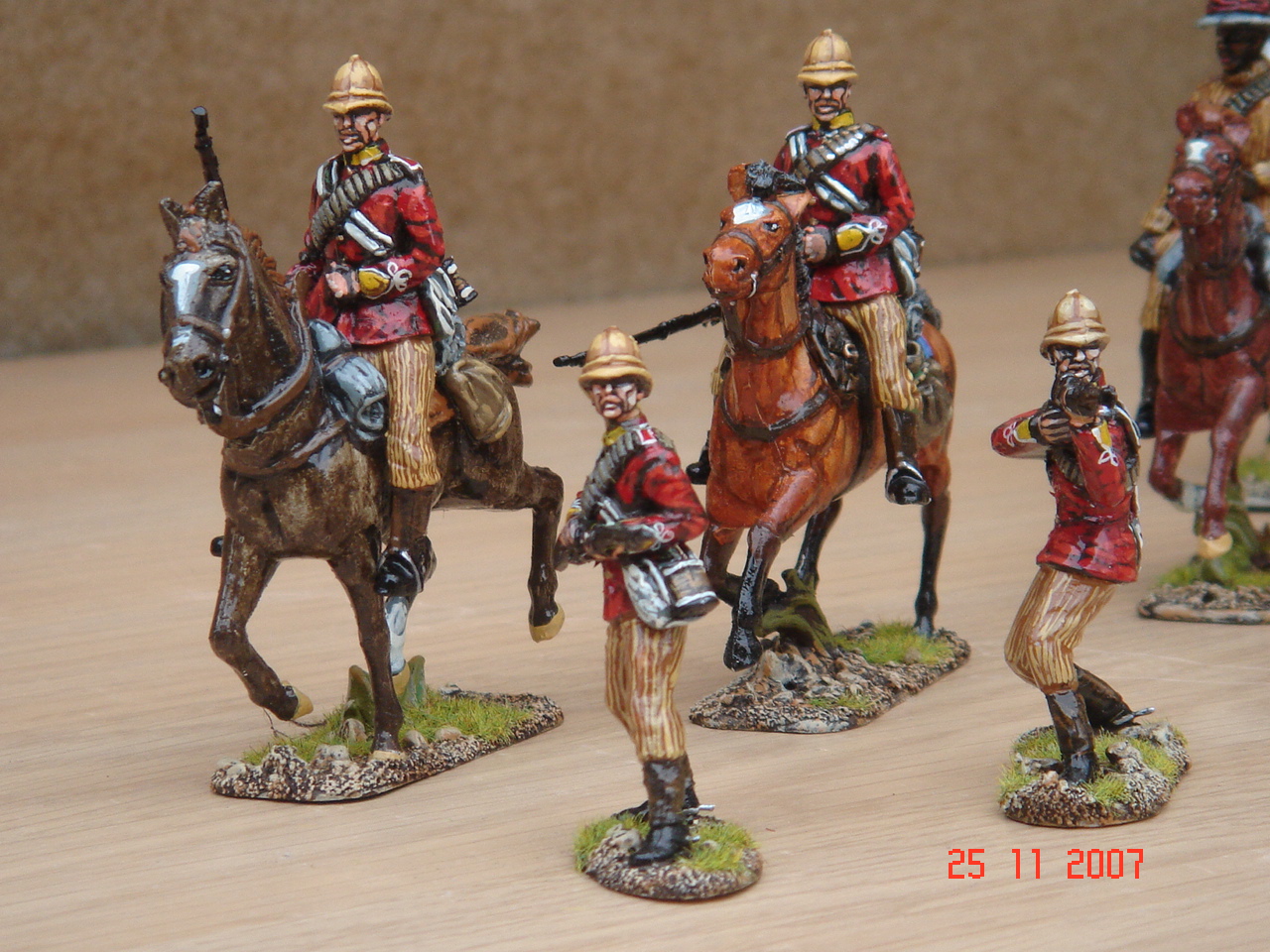
As I said last time about our attempt at the Zulu War is exemplified by the next few photos. I wanted to get away from the Zulus attacking a British defensive position, so we have only panted about 30 infantry and have started to concentrate on others, including cavalry and artillery. The results can be seen here, a couple of mounted infantry, mounted (of course) then duplicated on foot, a close-up of the Natal Carbineers shown last week and a Royal Artillery gun and detatchment. The gun is an Imex ACW piece with some seats constructed on the axles from scrap polystyrene, I was attempting to get the "look" of the thing rather than getting an accurate representation.
Lastly another pic of our new kit. K33, which is now up on the website and for sale.
Slightly shorter this week as we have to clear away the debris from the show.
Good luck to you all, and please comment or leave feedback, it shows someone out there is reading this.
Cheers
Eric

Sunday, 25 November 2007


Hello and welcome to the latest HELMET Blog. We start off this week's effort with a bit of HELMET PR in the form of our latest kit, Number K33, a French Infantry Officer in pre-1812 uniform. This can be painted in a number of ways including officers from the Young and Middle Guard, so you could use one to lead the Armies in Plastic French Napoleonic Infantry. Also in the kit I've included a few spare parts to enable the construction
of a mounted French ADC, again this figure can be used alongside the Italeri French General Staff set. We'll be launching the kit at the London Show on December 1st and it will be available from the website in the near future.
The next three pictures show some recent, I only finished the bases this morning, work where I have been looking at ways of providing opposition for the Americans I'm making for the War of 1812. The 6 figure picture is of a Canadian Fencible, a private from the 5th West India Regiment, and four men from the 95th Rifles, this hot is followed by close-ups of the two Redcoats and the Rifles. These are all basically HELMET figures as follows:
The Canadian Fencible, also can be a British Infantryman from the Peninsular War or even a member of Bernard Cornwall's South Essex, is a standard kit apart from his head, which uses a test shot of a stovepipe shako head with "standard" plate, we hope to have these available soon, as I think they'll open up a whole new area and can be used in America and Peninsular and elsewhere, for infantry and artillery models. The West Indian has his pack straps carved away and a bayonet scabbard added from scrap. Both have had their shoulder strap tufts built up from the ubiquitous greenstuff, always a challenge to my spellchecker! All the rest is achieved through paint.
The Rifles are pretty much basic HELMET kits, with an added waist belt and small pouch made from scrap plastic. The Baker rifle is just a cut down Brown Bess, shoulder straps ass before and one figure has shako cords in greenstuff. I wanted to add variety to the existing Riflemen that I already have ready to paint (Replicants and Italeri) and also I wanted a Bugler and Officer, you can see that latter on the Conversions page on the website. I'm quite pleased with the result, they look a bit different and to my biased eye, quite elegant.
I've mounted all the infantry models on small metal washers, which I bought very cheaply in a local "Pound shop", this provides a bit of stability and "heft" when picking them up and moving them.
Finally a taster, some cavalry from our Zulu War set-up, these are Natal Carbineers, mounted and dismounted. I really want to game in this period, but wanted to get away from hordes of Zulus attacking the 24th Foot in a defensive position so have started to build a few mounted units to have a more open type of game. The idea is to duplicate most of the mounted models so that they can fight on foot. The horses are Imex, although the Officer's mount has a metal head which I added as an experiment in variety, the dismounted figures are A Call to Arms British infantry with their kit carved away and new belts and bits from greenstuff. Pins and a dab of putty make the helmet spike. The mounted men started out as Cherilea Mounties, heads and gear as before with A Call to Arms weapons and boots added from other models as appropriate, all making up something a bit different.
Going now, have got stuff to do for the show next week. Comments and feedback welcome as before.
Cheers
Eric

Sunday, 18 November 2007


If it's Sunday it must be Blog time. Hello everyone from a wet, dank and dark south of England. We've spent most of the weekend getting stuff ready for our first show on December 1st at the Royal National Hotel in London. We've never done this before, and there seems to be so much to think about and prepare, but if you're coming to the show, drop by table A1 and say hell. I am continuing our quest to get some new HELMET products on the market, and I fully realise that we have at least one customer patiently waiting for new stuff out there, but I'm quite excited that we'll have some new and interesting items in the near future. I'll not mention this again until I know that we can actually supply the new bits and pieces.
So, on to this week's pictures. There is nothing new here, the show preparation has seen to that, but there should be some more War of 1812 pictures ready soon. I particularly like British 18th century uniforms, The Revolution and before, and have long been interested in the Jacobite Rising of 1745/1746 and the French and Indian War, so have devised a cunning plan whereby I can use the British troops for both conflicts. I realise that there are subtle uniform differences, but as I said in an earlier Blog, I paint and convert to get the "look and feel" rather than complete down to the last button accuracy. These grenadiers are mainly from the A Call to Arms grenadier set. I have trimmed their bearskins and produced mitre caps from the ubiquitous greenstuff, and added deeper cuffs and some additional bulk to their coat tails from the same material. The drummer is a metal figure from Dorset Soldiers and the officer is made by Barzo. The loading figure is from the Maryland Infantry set.
The Romans are mainly from the newish set from A Call to Arms, the conversion work consisted mostly of turning heads through 90 degrees so that at least some of them are holding their shields in front of them. I read somewhere that equipment was only replaced when it was worn out, and as this makes perfect sense, I used a few heads from the Toyway set and a mail clad body from Italeri. The centurion and a couple of legionaries are metal models from a New Zealand company who are no longer operating.
The two Napoleonic cavalrymen are made from HELMET spare parts. I saw a photo of a painting by Eugene Leliepvre on the front of an old Military Modelling - July 1984, I was only 10 at the time (not!) and was impressed by the simple but elegant uniforms. These are Declarers of the Guard, I think the nearest translation is "scouts" and were formed apparently to counter the threat from Russian Cossacks. We could issue these as a kit, what do people think?
Finally the Russian steamroller from the Crimean War. There are two companies from a line regiment here and about 20 packs of greenstuff. The figure come from the usual wide range of sources and take ages to make, but there is some compensation in the fact they are fairly quick to paint up.
That's all for now, any comments and feedback gratefully received.
Cheers and take care,
Eric